
Liz Suman, PayScale
Football's most famous fans may finally be getting a voice. After years of NFL cheerleaders enduring embarrassingly low pay and overall poor treatment, working conditions seem to be improving. As a recent New York Times article noted, "The cultural dial is turning." So, what exactly is changing, and why?
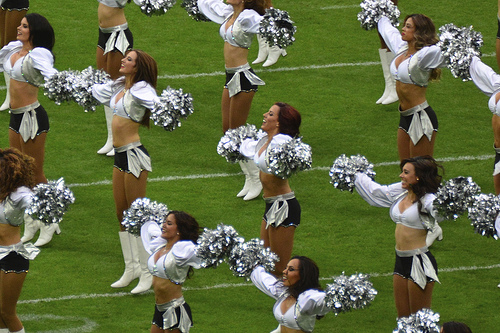
(Photo Credit: Pete Sheffield/Flickr)
Mistreatment
Though cheerleaders are forced to meet high athletic and aesthetic standards and keep jam-packed schedules (42 weeks of work a year, multiple practices a week, regular media and promotional appearances, and attendance at team events), the NFL has historically (and repeatedly) avoided paying minimum wage by citing cheerleaders' status as independent contractors, which exempts the League from abiding by state labor laws.
Up until September of last year, cheerleaders for the Oakland Raiders, known as Raiderettes, were paid a mere $125 a game, according to a recent pro-cheerleader op-ed in Time. Given that 11 games make up the average season, this adds up to roughly $1,250 a year in annual take-home, and an average hourly rate of less than $5 an hour.
Cheerleaders for the Baltimore Ravens and Tampa Bay Buccaneers cheerleaders make even less – $100 per game, according to Mother Jones. The Cincinatti Bengal Ben-Gals receive only $90. The New York Jets Flight Crew make slightly more – $150 a game – but the Buffalo Jills have it worst of all. Their primary compensation is a $90 game ticket and a $25 parking pass for home games, according to Mother Jones.
Former Raiderette Lacy Thibodeaux told the Times that Raiders cheerleaders were also not compensated for travel and other work-related experiences.
"Your contract states that you're not allowed to talk about your money," said Thibodeaux. "They think it's a joke, 'Oh, these little cheerleaders.'"
To put the compensation (or lack thereof) into perspective, cheerleaders make an estimated $8.25 million in game day TV appearances for the NFL, according to Time, and Commissioner Roger Goodell was reportedly compensated $44 million in 2013 alone.
Along with unfair compensation, additional subpar treatment has included insulting practices such as body fat and menstrual cycle monitoring, according to the Times. To cite one example, the Buffalo Bills Jills claim to being subjected to weekly "jiggle tests" designed to measure their fat.
Improvements
In July, California Governor Jerry Brown signed a bill requiring that cheerleaders be considered employees instead of independent contractors, which along with an enforced minimum wage, means breaks and paid sick leave, according to The Los Angeles Times. It will go into effect for the 2016 season.
Earlier this year, New York State Assemblywoman Nily Rozic and State Senator Diane Savino introduced a bill similar to California's, followed last week by a letter sent by a total of 18 policymakers representing eight states, requesting that NFL legally enforce a minimum wage requirement.
In reply to the letter, an NFL spokesman told The New York Times, "Teams are advised to follow state and federal employment laws. Under those laws, cheerleaders are not employed by the league."
Though the NFL's response wasn't especially promising, some state legislators are clearly increasingly making moves on the cheerleaders' behalf, as are the cheerleaders themselves, not only in the form of high-profile media attention but also legal action.
The latter has resulted in a handful of concrete changes, particularly in the wake of a slew of recent lawsuits filed by cheerleaders from teams including the Oakland Raiders, the New York Jets, the Buffalo Bills, the Cincinnati Bengals, and the Tampa Bay Buccaneers, some of which have resulted in victory for the cheerleaders.
In September 2014, the Raiderettes received a $1.25 million settlement from the Raiders following an eight month-long class action lawsuit filed against the team. The Buccaneers's cheerleaders received an $825,000 settlement following a suit of their own in March 2015. Both teams implemented minimum wage as of the 2014-2015 season. According to The LA Times, this means a guaranteed $9 an hour for the Raiderettes, plus overtime, and an overall annual increase from approximately $1,250 to 3,200 a year.
Super Bowl 2015: NFL Cheerleader Pay, Surprisingly Low, Fuels Ongoing Wage Debate
When the Seattle Seahawks and the New England Patriots sprint onto the field at University of Phoenix Stadium this Sunday, they’ll be framed by the glitter and pageantry of NFL cheerleaders. Indeed, it’s hard to imagine an NFL broadcast without shots of cheerleaders kicking out energetic dance routines, a key part of the presentation for millions of fans. But the dirty little not-so-secret reality for cheerleaders in the National Football League is that they’re paid less than almost anyone connected to the game -- often less than minimum wage -- according to many people familiar with professional football operations.
The seamy underside of NFL cheerleading came to light a year ago with a wage lawsuit brought against the Oakland Raiders by a cheerleader known as Lacy T, who claimed she was paid less than $5 an hour as a Raiderette. That lawsuit, a class action settled for $1.25 million in September, touched off a nationwide debate about fair pay, gender disparity and labor abuses on the peripheries of professional football fields, where tireless young women dance for 10-plus hours a day.
More cheerleader lawsuits followed, against the Cincinnati Bengals, the Buffalo Bills, the Tampa Bay Buccaneers and others. Soon what appeared to be an isolated labor grievance was looking more like a systemic problem. In a $10 billion industry where the minimum salary for a rookie player is upwards of $390,000, cheerleaders were making a pittance. Contracts for some teams paid only $125 a game while stipulating a litany of conditions regarding conduct. The women were required to attend rehearsals, practices and charitable events for no additional pay. They had to pay to clean their own uniforms. And those who showed the slightest weight gain were summarily benched, again with no pay.
A year after the lawsuit, Lacy T. told International Business Times she wished the NFL would be more active in pushing teams to pay cheerleaders a fair wage. “It’s really shocking that they expect such a high-quality product but aren’t willing to pay,” she said. “We trained our whole lives to get to this point. You have to have the right body type, look, personality, charisma and talent. It’s really is competitive.”
That said, Lacy notes some progress has been made. The Raiders have updated the contract for their 40-member cheer squad, now paying cheerleaders $9 an hour, California's minimum wage. Lacy is out of professional cheerleading now, but she keeps in touch with her old colleagues and said many Raiderette rookies are happy with the new terms. You might call her the Susan B. Anthony of NFL cheerleaders, a reformer who came forward to say something isn’t right.
Coming forward has been one of the biggest challenges in a glamour industry where simply being a part of it is an intoxicant. Cheerleaders are told they are lucky to be there -- and they feel lucky to be there. Many are terrified to speak out about pay, lest they get branded as troublemakers and blacklisted from future seasons.
“Trying to get a cheerleader to talk about what they get paid has been a big part of the issue,” said Diane Todd, a cheerleader advocate who launched an online petition calling on NFL teams to pay their cheerleaders a living wage, one that more closely reflects their contribution to football. Todd’s petition was signed by more than 144,000 people and backed by celebrities such as Paula Abdul.
Labor Of Love
Part of cheerleaders' reticence stems from the fact that some see the job as an opportunity whose benefits are not neatly defined by wages: It is a chance to be part of a sport that has gained an almost fabled place in American culture, or perhaps a steppingstone to a career in dance or entertainment. For others, it is simply labor of love. Many cheer out of a deep love for football.
Lacy said the vast majority of cheerleaders she worked with were either full-time students or had jobs that allowed them the flexibility to cheer on the side. “Nobody expects to make a living doing this,” she said.
She added there is no single career path that can be described as typical for cheerleaders. “They’re teachers, nurses, project designers, tech girls, engineers,” Lacy said. “I graduated in business management and entrepreneurship, and right now I’m a stay-at-home mom.”
And cheerleaders may stumble upon all sorts of ways to parlay their time with the NFL into good careers. Mireya Mayor, who cheered with the Miami Dolphins in the 1990s, went on to earn her Ph.D. in anthropology and later became a world-traveling correspondent for National Geographic, dubbed the “female Indiana Jones” by some in the press.
In an interview with IBTimes last year, Mayor echoed the sentiment of many cheerleaders who say cheering is a part-time passion, not a career. “I never did it for the money, clearly,” she said at the time. “I did it because I love football, because I love to dance.”
But to fair-wage advocates and labor lawyers, that love of football is beside the point. Loving a job, even a part-time one, doesn’t diminish its marketplace value. “People make the assumption that cheerleaders -- because they’re part of the NFL -- they’re paid a really good salary,” said Todd.
Cheers And Jeers
Since Lacy’s lawsuit broke, the NFL has said little on the subject. Asked about cheerleader pay Tuesday, Brian McCarthy, an NFL spokesman, said the league has nothing to do with cheer squads or cheerleader wages. “You would have to speak to the teams,” he said.
We tried. But the teams don’t seem interested in speaking about the issue either. Phone calls and emails to representatives of the Seahawks and the Patriots, the teams competing in Sunday’s Super Bowl, went unreturned. Ditto for the cheerleading squad directors of those teams.
Drexel Bradshaw, a San Francisco lawyer who is representing a number of cheerleaders in wage lawsuits, said the NFL is trying to have it both ways, washing its hands of responsibility while issuing directives about what cheerleaders can and can’t do. Behind the scenes, he said, league officials are doing what they can to prevent more lawsuits. “I believe the league has quietly whispered in the ear of the franchise owners, saying, 'Let’s get in line so we don’t have any more problems,' ” Bradshaw said.
In the meantime, some lawmakers are starting to pay attention, most notably in California. On Thursday, Assemblywoman Lorena Gonzalez, D-San Diego, introduced a bill that would treat cheerleaders for professional sports teams as employees, thereby closing a loophole that critics say allows some teams to treat them as volunteers. In a statement, Gonzalez called out NFL teams and their “billionaire owners” for capitalizing on the talents of cheerleaders without providing even “the most basic workplace protections.”
The timing of the bill -- three days before Super Bowl XLIX -- was probably not a coincidence, but it speaks to the momentum behind Lacy T.’s legacy.
As for Lacy herself, despite her yearlong legal fight, she said she harbors no ill will toward the Raiders and called her time on the squad “amazing.” With a polite chuckle, she said some of her former colleagues stopped speaking with her after the lawsuit, failing to understand why she would want to jeopardize a dream opportunity. But then dreams and labor laws needn’t be mutually exclusive.
“That’s really what I was fighting for,” she said. “It wasn’t millions of dollars. I wasn’t saying we deserve what the players deserve. It was all about fair pay, and I have absolutely no regrets.”
Christopher Zara
Nenhum comentário:
Postar um comentário